

1. Before getting in the water: essential preparation
Learn to read the ocean
Surfing doesn't start on the board. It starts on the beach, by observing. Before each session, spend at least 10 to 15 minutes analyzing the conditions:
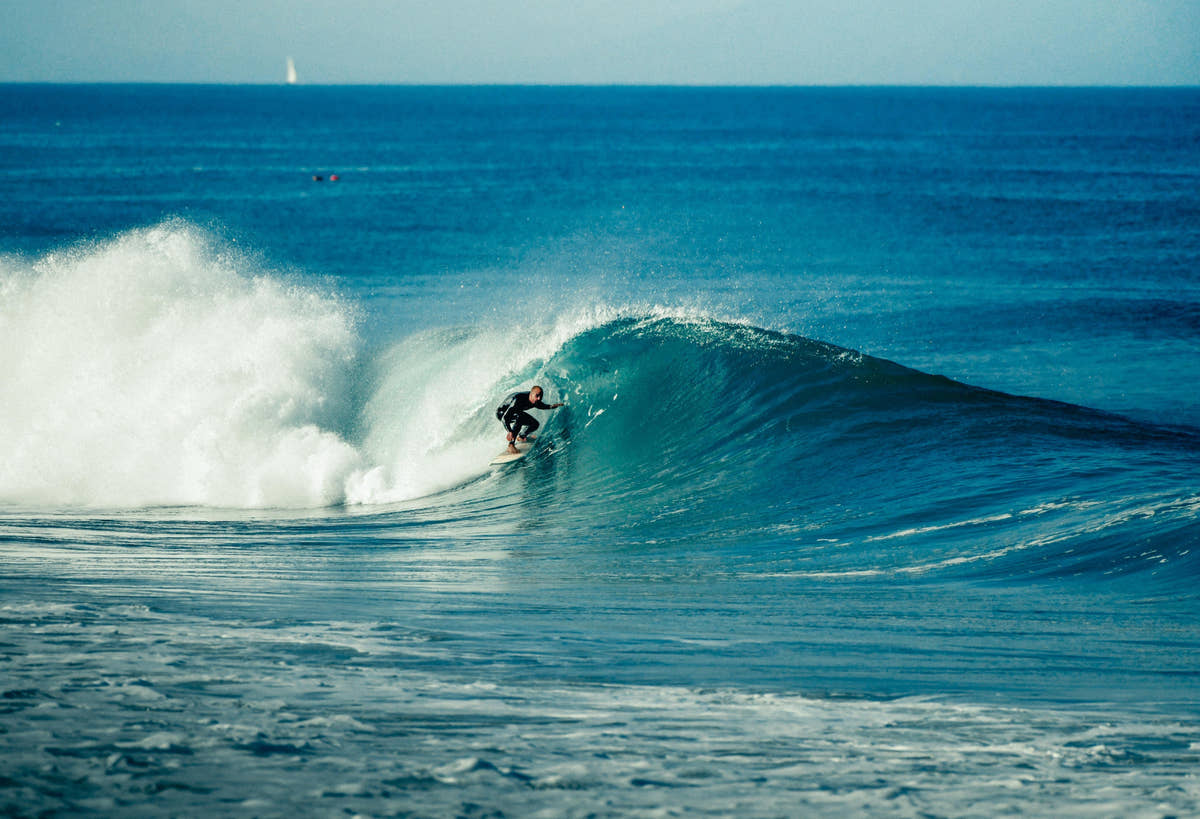
Spot the sandbanks and the peaks (areas where waves form and break). Identify the currents: those areas of calmer, darker water where water flows back out to sea. Currents are dangerous for beginners because they can pull you away from the shore quickly. Observe the wind direction and strength. An offshore wind (blowing from land to sea) hollows out the waves and makes them better. An onshore wind (from the sea to the land) makes them mushy and disorganized. Note the frequency of the sets: how many waves arrive together, at what rhythm, and what their actual height is once you're in the water.
Reading the ocean like this is a fundamental skill that you will refine throughout your life as a surfer.
Honestly evaluate your swimming level
To start surfing safely, you must be a comfortable swimmer. You don't need to be a champion, but you must be able to swim 200 meters without getting exhausted, stay calm in choppy water, and move confidently even when you cannot touch the bottom. If that's not the case yet, start by strengthening your swimming before you take up surfing.
Choose the right conditions for starting out
As a beginner, you don't need big waves. Quite the contrary. The best conditions for learning are soft, steady waves of 50 cm to 1 meter, a sandy bottom (avoid reefs and rocks), little wind, little current, and a sea that isn't too crowded. Beach breaks in summer, with a light offshore wind in the morning, are ideal conditions.
2. Taking lessons: the smartest decision
Why taking lessons is essential
Many beginners think they can learn on their own by watching YouTube videos. It's possible eventually, but very ineffective at the start. A qualified instructor will teach you the right techniques from the beginning, which prevents you from picking up bad habits that are slow to correct. They will also teach you the safety and priority rules in the water, which are essential for surfing without putting others in danger.
How to choose your surf school
Opt for a school affiliated with the French Surf Federation (FFS) or an official equivalent in your country. Instructors holding the BPJEPS Surf or the state diploma are trained to supervise beginners safely. Ask about group sizes: ideally, one instructor for a maximum of 6 to 8 students. Prefer schools located on spots suited to beginners, with consistent waves and a sandy bottom.
How many lessons should you plan?
A 5-day course is the most common and effective format for absolute beginners. By the end of this week, most students are able to stand up on the board and surf a few white waves. To really progress, count on several courses over one or two seasons, combined with regular independent sessions.
3. The essential equipment for a good start
The board: bet on volume
As mentioned in our guide on choosing a surfboard, the rule is simple: start big and voluminous. For an absolute beginner, a softboard (soft foam board) or an EPS longboard of 8 to 9 feet with 60 to 80 liters of volume is the ideal choice. Foam is safer in case of impact and floats better, which makes paddling and catching waves easier.
The leash: never surf without it
The leash is the cord that connects your ankle to the board. In case of a fall, the board stays nearby and serves as a buoy. For starting out, choose a leash the same length as your board, 7 to 8 millimeters thick. Always attach it to your back ankle (the one towards the back of the board when you are surfing).
Wax: so you don't slip
Wax is applied to the top of the board to create grip for your feet. Choose wax adapted to the water temperature: cold water for cold water (below 16°C), warm water for warmer water. Apply it in circular or crosshatch motions over the entire area where you will place your feet.
The wetsuit
In France, even in summer, the water remains cool (16 to 22°C depending on the region and season). A wetsuit is almost always necessary. The thickness depends on the water temperature: a shorty or a 3/2 mm for summer, a 4/3 mm for autumn and spring, a 5/4 mm for winter. A well-fitted suit should not restrict your shoulders or let in too much water. Invest in a quality model: it is your best protection against the cold.
4. Technical basics to absolutely master
Paddling: the foundation of everything
Paddling, i.e., how you row while lying on the board, is the most important and most underestimated skill in surfing. A good paddler catches many more waves and gets tired much less. Here are the essential points:
Position yourself in the center of the board, not too far forward (the nose dives), nor too far back (the tail sinks and slows you down). Your feet should be held together and point backwards. Keep your head up, eyes on the horizon. Paddle with your arms fully extended, entering your hand into the water gently, palm facing down. Pull from front to back, running along the rails of the board. Alternate arms regularly and keep a constant rhythm.
Practice paddling even in calm conditions, far from the waves. Paddling is worked on and improved with repetition.
The take-off: standing up on the board
The take-off is the moment when you move from a lying position to a standing position. It is the most important technical movement to learn, and it is repeated thousands of times. Here are the steps:
Feel the wave pushing you and accelerate your paddling. At the moment when the board accelerates on its own, carried by the wave, place both hands flat on the board at chest level. Perform an explosive movement: push off your hands and bring both feet under your body simultaneously, in a single motion (avoid getting up knee by knee; it's a bad habit). Place the back foot first, then stabilize with the front foot. Your feet must be perpendicular to the board's axis, shoulder-width apart.
Regular or goofy? If you are naturally "regular," your left foot is in front. If you are "goofy," it's your right foot. To determine this: imagine someone pushes you from behind unexpectedly. The foot you instinctively step forward to catch yourself is your front foot.
Practice the take-off on the sand before going into the water. Repeat the movement dozens of times on dry land until it becomes automatic.
The standing position: balance above all
Once standing, adopt a stable and relaxed position. Knees slightly bent, body weight centered on the board, arms spread for balance, gaze directed forward (never at your feet). Surfing requires you to look where you want to go: your body will naturally follow.
Avoid tensing up. Tension is the enemy of balance. The more relaxed you are, the more you will naturally absorb the wave's irregularities.
The dry pop-up: your daily training
The pop-up (another name for the take-off) can and must be trained out of the water. Five minutes of dry pop-ups each morning will allow you to progress much faster than an hour in the water fumbling around. Set yourself up on a yoga mat or the board laid flat, mark your foot position with a marker if necessary, and repeat the movement until it is fluid and natural.
5. Safety and priority rules in the water
Essential safety rules
Never surf alone, especially at the beginning. Always keep your leash attached to your ankle. Never let go of your board intentionally: it can injure other surfers. Check the space around you before catching a wave. If you are caught in a current, do not fight it head-on: swim diagonally to slowly move out of it or signal for help from the beach.
Respect marked swimming areas. In France, surfers must surf outside the zones delimited by yellow and red buoys, which are reserved for swimmers.
The priority code between surfers
In the water, unwritten rules govern coexistence between surfers. Knowing and respecting them is an essential display of etiquette.
The main rule is priority on the wave: the surfer closest to the peak (the point where the wave breaks) has priority. Don't "snake" someone else's wave if they are already catching it. Only one person per wave. Do not paddle into the path of a surfer standing on a wave. Respect surfers who have been waiting in the line-up longer than you.
As a beginner, stay on the white water (foam, after the wave has broken) until you master the basics. That is where you should learn, without disturbing more experienced surfers who are waiting for green waves out in the deep.
6. Physical fitness: preparing for surfing
Why physical preparation matters
Surfing engages the whole body: shoulders and back for paddling, legs and core for balance, and cardio to chain waves together without exhaustion. Good general physical fitness will allow you to enjoy each session more and progress faster.
Exercises to incorporate before and during learning
Swimming is the number one complementary exercise for surfing. It improves cardio, strengthens shoulders, and makes you more comfortable in the water. Swim at least twice a week if possible.
Yoga is favored by many professional surfers. It improves flexibility (essential for the take-off), core strength, and body awareness. Ten to twenty minutes a day is enough to feel the benefits.
Work on your core with plank exercises (front plank, side plank) to stabilize your body on the wave. Also include squats and lunges to strengthen thighs and knees, which are highly stressed in a surfing stance.
Warming up before each session
Never neglect warming up, even in hot weather. Before entering the water, perform five to ten minutes of joint mobility exercises: shoulder, wrist, and ankle rotations, and light stretches for the back and hips. A warmed-up body reacts better, gets injured less, and performs better.
7. Classic beginner mistakes (and how to avoid them)
Looking at your feet. This is the most common mistake. Looking at your feet throws off your posture and makes you fall. Get used to looking forward from the beginning.
Getting up too early or too late. The timing of the take-off is crucial. Too early, and the wave isn't carrying you yet. Too late, and the wave takes you uncontrollably. Learn to feel the exact moment when the board accelerates.
Paddling too far back. If your weight is too far back, the tail of the board sinks and you slow down. Move slightly forward on the board until you find the perfect balance.
Neglecting to paddle between waves. Beginners tend to rest between waves and let the current pull them back toward the beach. Paddle actively to stay in the wave-catching zone.
Choosing sessions that are too difficult. Waves that are too big or conditions that are too choppy are counterproductive and dangerous for beginners. Be honest with yourself and choose conditions adapted to your actual level.
Getting discouraged too quickly. Surfing is a discipline that takes time. It often takes several sessions before catching your first real wave while standing, and months to master it. The progression curve might seem slow at first, then accelerates considerably with consistency.
8. Progressing steadily: keys to continuous improvement
Consistency above all
Two sessions a week are better than one intensive monthly session. Surfing is learned through repetition. Each session, even a short one, consolidates techniques, refines wave reading, and builds physical fitness. If you don't live by the water, compensate with swimming, skateboarding (which develops a sense of balance), and dry-land exercises between trips to the coast.
Film yourself
Nothing is more useful for progress than seeing yourself surf. Ask a friend to film you from the beach. By watching yourself, you will immediately identify posture flaws, bad timing, and areas for improvement that you don't perceive while in the water.
Join a community
Surfing is also a culture and a community. Joining a local surf club, participating in guided outings, or simply getting into the habit of surfing with people at your level will motivate you and help you improve. Exchanges with more experienced surfers are an invaluable source of advice.
Keep a surf journal
Note the conditions of each session (wave size, wind, tide), what you succeeded at, and what you want to improve. This simple tracking allows you to measure your progress, identify your strengths, and target your efforts.
Conclusion: surfing, an art that requires time and passion
Starting to surf means committing to a long-term learning process, full of falls, laughter, frustrations, and immense joys. The first waves caught standing up are among the most exhilarating sensations a sport can offer. And that feeling never disappears, regardless of your progress.
Remember the essentials: take lessons with a qualified instructor, choose a board suited to your level, respect the sea and other surfers, and be consistent. The rest will come naturally, wave after wave.
The ocean is patient. Be patient too.

Share:
How to choose your surfboard
What wetsuit should I get for surfing?